
What Is a Reflective Essay — and How Is It Different?
A reflective essay asks you to look back at a specific experience — a clinical shift, a group project, a teaching practicum — and write about what it taught you. Unlike a standard research paper, you write in first person (“I”) and draw on your own perspective.
A reflective essay is your personal analysis of an experience, not a diary entry. Here’s what every student needs to know:
- It’s a story with purpose. You describe an experience, analyze it using course theory, and propose concrete next steps.
- Use the 15-20-60 rule. Keep description to 15-20% of your word count, let analysis dominate at 50-60%, and finish with 15-25% conclusion/action. Most students write too much description and not enough analysis.
- Your thesis must connect experience to theory. Don’t just state what happened — explain what it taught you about your field.
- Pick your framework. Gibbs’ cycle works best for longer essays (nursing, education). The What/So What/Now What model is ideal for short reflections under 1,000 words.
The challenge? Your professor doesn’t want a journal entry. A reflective essay needs academic structure: thesis statement, theoretical analysis, and actionable conclusions. The line between “personal reflection” and “academic reflection” is the difference between a B and an A.
Related reading: Reflection Paper vs. Reflection Essay: Key Differences & Examples
Here’s the core distinction: a reflection paper focuses on the experience itself and your feelings about it. A reflective essay uses the experience as a starting point to analyze what you learned through the lens of academic theory and field-specific knowledge.
Three Frameworks to Organize Your Reflection
You don’t need to memorize every framework, but knowing the most common ones helps you match your assignment to the right structure.
Gibbs’ Reflective Cycle (1988)
The most widely used framework in nursing, education, and healthcare programs. It has six stages:
- Description — What happened?
- Feelings — What did you feel?
- Evaluation — What was good and bad?
- Analysis — Why did it happen? (This is where theory comes in.)
- Conclusion — What else could you have done?
- Action plan — What will you do differently next time?
The cycle is visual:
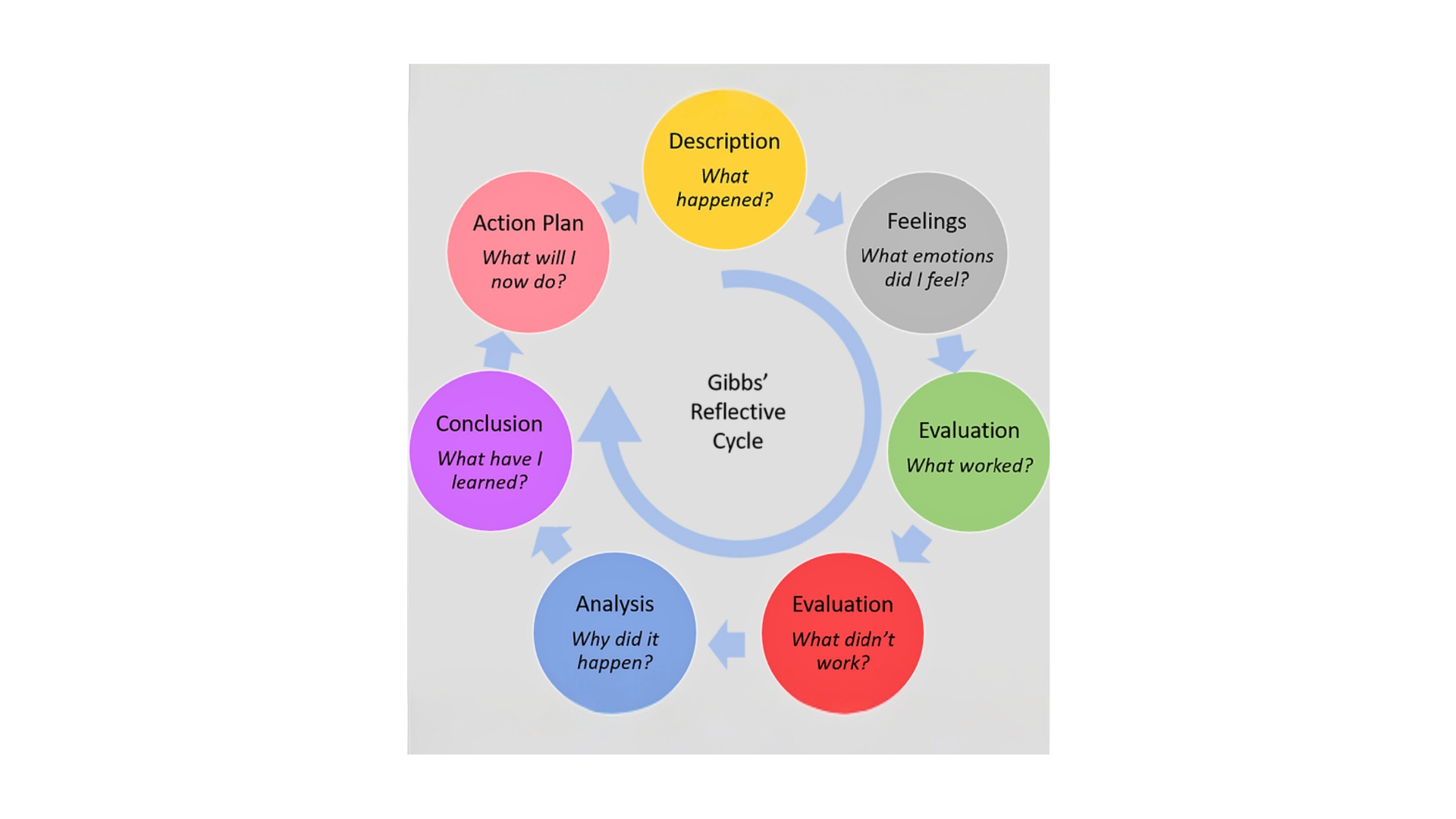
Diagram: Gibbs’ Reflective Cycle by Saul McLeod, PhD, Simply Psychology
When to use it: Longer essays (1,500+ words), nursing, healthcare, and education programs. It’s the default model at most UK and Commonwealth universities.
The 5R Framework (Bain et al., 2002)
Five steps: Recognizing your experience, Reflecting on it, Relating it to theory, Reasoning through the implications, and Reconstructing your understanding.
When to use it: Education programs and professional development courses. It’s simpler than Gibbs’ cycle and focuses more on theoretical connection than the emotional processing stage.
What / So What / Now What (Rolfe, 2010)
The simplest framework — three questions:
- What? Describe the experience.
- So what? Analyze it using theory and your insights.
- Now what? Propose concrete next steps.
When to use it: Short reflections under 1,000 words, or when your professor doesn’t specify a framework. It’s the easiest model to teach students who are new to reflective writing.
Need deeper framework guidance? Read the full guide on Gibbs’ cycle, 5R model, and tri-level frameworks.
Step-by-Step: Writing Your Reflective Essay
Step 1 — Write a Thesis Statement That Connects Experience to Theory
Your thesis is the hardest sentence to write, and it’s the single most important one in your essay. It should do two things: state what happened and preview the lesson you learned.
Weak thesis: “I went on a clinical placement and it taught me a lot about nursing.”
Strong thesis: “My first clinical shift in the intensive care unit challenged my assumptions about patient communication; through the lens of Benner’s novice-to-expert framework, I realized that technical competence cannot be separated from the emotional labor of listening.”
See the difference? The weak thesis is vague and personal-only. The strong thesis connects your experience to academic theory and gives your reader a clear roadmap of what you’ll explore.
Want more thesis guidance? How to Write a Thesis Statement: Complete Guide
Step 2 — Describe the Experience (Briefly)
Keep this section short. You’re setting the scene, not writing a novel. Aim for 15-20% of your total word count. Include:
- Context (where, when, who was involved)
- What specifically happened (one concrete moment, not a whole week)
- Your initial feelings
Example (nursing student, 2,000-word essay — description should be ~300 words):
During my third-year intensive care rotation, I was assigned to care for Mr. Davies, a 67-year-old patient admitted for acute respiratory failure. For the first time without a buddy nurse, I had to perform a full admission assessment. I felt overwhelmed when his oxygen saturation dropped from 96% to 89% within 20 minutes of my shift beginning — and I froze before calling the charge nurse.
Step 3 — Analyze Using Academic Theory (This Is Where You Earn Your Grade)
This is the heart of your essay and should take 50-60% of your word count. Professors grade on theory integration — if your reflection reads like a journal entry with no academic framework, it scores poorly.
Connect your experience to at least one theory from your coursework:
- Nursing: Benner’s novice-to-expert stages, Watson’s theory of human caring, or clinical reasoning models
- Business: Kolb’s experiential learning cycle, situational leadership theory, or ethical decision-making frameworks
- Education: Vygotsky’s scaffolding, reflective practice models, or culturally responsive teaching frameworks
Example (business student, analyzing a failed group project):
Looking through Kolb’s experiential learning cycle, I can see I was stuck in the concrete experience stage — I focused entirely on what happened (“we didn’t communicate well”) without moving into abstract conceptualization (“what learning theories explain our communication breakdown?”). This maps directly to what Leat and Smith (2001) describe as the ‘reflection trap’: describing without analyzing. My group didn’t fail because we were unintelligent; we failed because we treated the project as a task list rather than a learning experience.
Step 4 — Conclude and Create a SMART Action Plan
Your conclusion isn’t just a summary. It’s where you answer “what will I do differently?” The best action plans follow the SMART framework: Specific, Measurable, Achievable, Relevant, and Time-bound.
Weak action plan: “I will do better next time.”
SMART action plan: “In my next group project, I will create a shared timeline with internal deadlines two days before submission, and I will schedule a 15-minute check-in with each team member before our final week to catch any gaps in understanding.”
The SMART template works across all disciplines:
| Component | Weak Example | SMART Example |
|---|---|---|
| Specific | “I’ll be a better leader.” | “I will delegate one task per person during our next project meeting.” |
| Measurable | “I’ll improve my communication.” | “I will send a weekly summary email to all stakeholders.” |
| Achievable | “I’ll never be late.” | “I will set two alarms and leave 15 minutes earlier.” |
| Relevant | “I’ll read more.” | “I will review the case study two days before our next practicum.” |
| Time-bound | “I’ll fix my mistakes.” | “I will complete a self-assessment checklist before every clinical shift by the end of the semester.” |
Your conclusion should also tie back to your thesis. If you promised to explore how X theory changed your understanding, restate that connection briefly before launching into your action plan.
Discipline-Specific Examples
Different fields expect different kinds of reflection. Here’s how three common disciplines approach the same core structure.
Nursing / Healthcare
Nursing reflective essays almost always use Gibbs’ cycle because patient interactions involve both technical and emotional components. The expected structure:
- Describe a clinical event — a patient interaction, a procedure, a communication breakdown
- Explore your emotional response — guilt, anxiety, confidence, surprise
- Apply nursing theory — Benner’s stages, ethical frameworks, communication models
- Identify learning — what this revealed about your clinical competence
- Set an action plan — specific skills to develop, knowledge gaps to address
Example opening (education/teaching practicum):
During my first week of teaching practicum at Lincoln Elementary, I designed a lesson on fractions that I was proud of. But when I delivered it, I watched 14-year-olds stare at the whiteboard with confused expressions. I had assumed visual examples would make the concept click — but I hadn’t considered that my students were still mastering decimals from the previous unit. Through Vygotsky’s scaffolding theory, I realized my mistake wasn’t poor design; it was poor sequencing. I had built the scaffolding too high before the students had the foundation.
Theory to reference: Benner’s novice-to-expert framework, Vygotsky’s scaffolding, reflective practice models (Schön), or the reflective cycle frameworks above.
Business / Management
Business reflective essays focus on team dynamics, leadership, and decision-making. They connect personal experience to organizational behavior theories.
Example analysis:
My experience leading the marketing project maps onto situational leadership theory (Hersey & Blanchard, 1979). I adopted a telling style with my team — giving direct instructions and minimal input — because I was confident and our deadline was tight. But the theory I studied in Week 3 would have predicted this approach only works when team members are both able and willing. When motivation dropped mid-project, I should have shifted to a participative style. Instead, I kept giving orders, and that’s when our engagement metrics fell.
Theory to reference: Kolb’s experiential learning, situational leadership, ethical decision-making models, or organizational behavior frameworks.
Education / Teaching
Education reflective essays connect classroom experiences to learning theory and pedagogical frameworks. They emphasize culturally responsive teaching and student-centered approaches.
Example conclusion:
Reflecting on my practicum through the lens of culturally responsive teaching (Gay, 2010), I recognize that my lesson design centered on a single cultural perspective. While my materials were academically rigorous, they didn’t reflect the cultural backgrounds of 60% of my students. Going forward, I will audit my resource library each semester, solicit community input, and incorporate multilingual materials into my lesson plans.”
Theory to reference: Vygotsky’s scaffolding, Dewey’s reflective practice, culturally responsive teaching frameworks, or the tri-level model for shorter reflections.
Formatting: APA vs. MLA
The formatting you use depends on your discipline and professor’s preference. Most nursing and science programs require APA; most humanities and education programs may use MLA.
APA (American Psychological Association)
- First-person voice is acceptable in reflective writing
- Use headings for structure (Level 1, Level 2)
- Cite theories and authors in parentheses: (Benner, 1984)
- Include a reference list at the end
- Font: Times New Roman, 12pt
MLA (Modern Language Association)
- First-person voice is acceptable
- No separate heading required; title centered on first page
- Use running head with last name and page number
- Cite authors with page numbers: (Smith 15)
- Works Cited page instead of reference list
- Font: Times New Roman, 12pt
Key tip: Check your assignment guidelines carefully. Some professors want APA for the citation style but MLA for the structure (or vice versa). If your professor doesn’t specify, ask.
The Word Count Ratio Rule (Your Writing Template)
Here’s the single most actionable framework you can take from this article. Professors consistently reward essays that follow this balance:
The 15-50-25 Template
| Section | Word Count % | What to Include | What to Avoid |
|---|---|---|---|
| Description / Feelings | 15-20% | Context, what happened, initial emotions | Whole-week summaries, irrelevant details |
| Analysis / Theory | 50-60% | Academic theory, personal insight, critical thinking | Re-describing the experience, vague generalizations |
| Conclusion / Action Plan | 15-25% | Summary of learning, SMART next steps | New information, generic statements |
How to use this template:
- Write a 2,000-word essay.
- Calculate 15% of 2,000 = 300 words for description. That’s your ceiling for the experience section.
- Calculate 55% of 2,000 = 1,100 words for analysis. This is where your real work goes.
- Calculate 20% of 2,000 = 400 words for conclusion and action plan.
If you find yourself writing 500 words of description, cut it. The description should be a doorway into the analysis, not the destination itself.
Common Mistakes to Avoid
1. Writing a diary entry instead of an academic essay
“Dear journal, today was hard. I felt sad.” This is what you write at home. Your reflective essay needs you to step back and analyze why things happened — using academic theory and structured reflection.
2. Over-describing and under-analyzing
This is the #1 mistake. Students spend 80% of their essay describing events and only 20% analyzing them. The analysis section is where you earn your grade. Every paragraph of description needs a corresponding paragraph of analysis.
3. Naming a theory but never applying it
Mentioning Benner or Kolb without explaining how your experience maps onto their framework is like listing ingredients without cooking. Show the connection.
4. Writing vague action plans
“I will be better” is not a plan. An action plan needs specificity, measurability, and a timeline. Use the SMART template above.
5. Ignoring the theoretical lens
Reflective essays without theory integration read as personal narratives, not academic work. Professors want to see what you’ve learned about your field — not just about yourself.
Final Checklist for Your Reflective Essay
Before you submit, run through this checklist. It covers structure, content, and academic standards.
- [ ] Thesis statement connects experience to theory
- [ ] Description is brief (15-20% of word count)
- [ ] Analysis dominates (50-60% of word count) with theory integration
- [ ] Action plan is SMART — specific, measurable, achievable, relevant, time-bound
- [ ] Framework is applied — Gibbs, 5R, or tri-level (whichever your assignment requires)
- [ ] First-person voice is used throughout (“I” is expected and appropriate)
- [ ] Academic tone maintained — no diary-style language
- [ ] Theory cited properly — names, dates, page numbers where required
- [ ] Formatting correct — APA or MLA as specified by your professor
- [ ] No new information in conclusion section
- [ ] Internal links to related content:
- [ ] Academic Writing Checklist for citation and formatting reference
- [ ] How to Write an Annotated Bibliography for research prep
Summary — What You Take From This Article
Writing a reflective essay isn’t about writing well — it’s about thinking well and showing your professors that you can connect experience to theory. Here’s your roadmap:
- Pick your framework. Gibbs’ cycle for longer essays, What/So What/Now What for short reflections.
- Keep description brief. 15-20% of your word count. Set the scene, don’t live there.
- Let analysis dominate. 50-60% of your essay. This is where you use theory and earn your grade.
- Write a SMART action plan. Be specific, measurable, and time-bound.
- Follow the formatting guide. APA for nursing/science, MLA for humanities/education — unless your professor says otherwise.
The difference between a good reflective essay and a great one is the ratio: most students write too much description and not enough analysis. Use the 15-50-25 template as your writing scaffold, and your essay will have the structure professors expect.
Further Reading
- Reflection Paper vs. Reflection Essay: Key Differences & Examples
- How to Write a Thesis Statement: Complete Guide
- Academic Writing Checklist
- Contact us for tutoring or editing help
- Place an order for custom essay assistance

